One modular core, deployed across emergency management, education and clinical care. In every deployment the system proposes and a qualified human decides. That constraint is enforced in code, not in policy.
How it came about
Nothing here was a pivot.
Each system was built to solve a problem in front of us. The next one fell out of the one before it. The order matters, because it explains why a company working in mental health was built to emergency-management discipline.
2021
Huddle
The T.C. Hilton Foundation built a secure conferencing and voting system for its own outreach work. No artificial intelligence of any kind — a video platform with verified participation.
2022
Huddle spun out, then licensed
Scaling it exceeded what a foundation should carry, so Huddle was spun off to Huddle LLC. Later that year a multinational licensee acquired worldwide rights to the codebase. It remains in production today. That licence covers a platform containing no AI — every agentic system built afterward sits outside it.
2023
STEP Education
Conferencing infrastructure made structured group instruction possible, which raised a harder question: how do you tell whether a student is actually learning? That question produced our first agentic AI work.
2024
Incident command and flood prediction
A county emergency management authority needed real-time incident action planning. We built a compartmentalized, self-hosted agentic architecture under complete chief-in-the-loop control, with live flood and hurricane-incursion prediction plotted on a federal baseline. The governance discipline in every later system was established here.
2025
Sage
Disaster response surfaced a need the incident system could not meet: outreach to people affected by an event. The guide built for that work became Sage.
2026
Better Together
Disaster counselling generalised into clinician-led group therapy. Sage has been the centre of the work since, and is now being placed permanently under foundation ownership.
What it is
One core. Several deployments.
Cognogin is not a portfolio of separate products. It is a single modular core — 182 API modules across roughly three million lines of code — configured for different domains.
Better Together, STEP Education and the incident command platform are extended feature sets of that core. Same engine, same measurement, same governance, same safety floor. What changes is the standards layer and the vocabulary.
That has a practical consequence: capability demonstrated in a low-risk domain transfers to a high-risk one, because it is the same engine and not an analogy.
182API modules today. The count moves as modules consolidate.
~3MLines of code across the platform
9Provisional patents filed, one further in review
100kConcurrent participants at full interaction
Governance
The system proposes. The human decides.
Most AI products are built to act, with a human able to intervene. Ours is built so that the human acts, with the system able to propose. The difference is not a setting.
Sage does not run free. Every session moves through a fixed sequence of gates enforced in code rather than requested of the model. It holds no private state between turns — if something is not in the session record, it does not exist to the system. And it has no direct write access to anything: every change passes through a single controlled gateway that logs it.
Behaviour is bounded and auditable rather than emergent. An operator can see what happened and why. So can a regulator, and so can we.
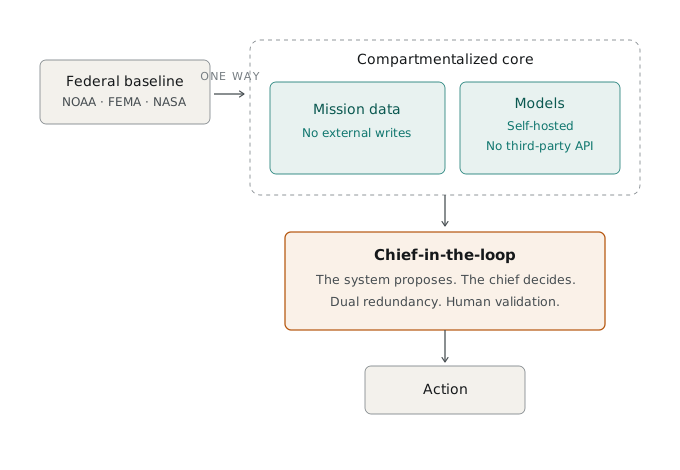
The governance architecture as deployed in incident command. Federal data from NOAA, FEMA and NASA forms the baseline and enters one way only. Real-time operational data is plotted on top of it. Models are self-hosted; no third-party API is called.
Deployments
Where the core runs today.
Incident commandBuilt · operational
Emergency management
Real-time incident action planning, flood and hurricane-incursion prediction, and resource logistics under chief-in-the-loop control. Fully functional today. Set aside by choice to concentrate on clinical work; current Sage has not yet been integrated into it.
Better TogetherField testing
Clinician-led group therapy
A licensed clinician leads every group of eight to ten participants and makes every clinical decision. The platform carries measurement, between-session continuity and documentation, so the same clinical staff can run more groups without lengthening anyone's week. Clinical validation is not complete.
STEP EducationBuilt · operational
Curriculum and measurement
Curriculum authored once becomes a deployable module, sequenced to any group and adapted per learner. The system locates where a student is actually stuck, which is usually not where the failure shows up.
HuddleIn production
Conferencing infrastructure
The secure conferencing and verified-participation layer beneath the others. Contains no AI. Licensed worldwide to a multinational operator and in production use.
Status, stated plainly
What is proven and what is not.
We would rather be precise about this now than have it surface later.
System
Status
Incident command
Built, working, operational. Real-time prediction and logistics functional. Current Sage not yet integrated.
STEP Education
Architecture complete and functional. Curriculum authoring, sequencing and per-learner adaptation working. Limited curriculum built to date.
Better Together
In field testing. Clinical validation not complete. Our Clinical Director holds sole authority over that and has not signed off. We are publishing no outcome or efficacy figures.
Huddle
In production under licence.
Sage
The shared engine. Under active development and moving into permanent foundation ownership.
No outcome claims appear anywhere on this site.
Clinical validation of Better Together is incomplete, so any figure we published today would be provisional. When results are real, we will publish them and say how they were obtained.
Ownership
Sage cannot be bought.
The Sage intellectual property is held by the T.C. Hilton Foundation, a private foundation, and is being placed permanently beyond commercial reach. It cannot be acquired by a company, licensed away, or repointed at someone's growth targets. Commercial entities operate it under licence; none of them owns it.
To a commercial partner that reads as a constraint. To an institutional buyer it is the opposite. The question every government programme asks second is what happens when the vendor is acquired. Here, the thing they would depend on cannot be.